
Learn / Where robots are going · 2 min read
Yes, your video trains robots
What the videos are for, said plainly
Yes. The video you record helps teach robots and AI how cleaning work is done. Teams want it because robots are still bad at hand work, and there is very little video of it. That does not put a robot on your route this year. We want you to hear it from us first.
- 1You recordA cleaner wears the phone and does the normal job.
- 2You uploadThe video goes up through the recording app.
- 3We check itOur team reviews quality within 24 to 48 hours.
- 4It gets labeledTasks, hands and tools are marked in the video.
- 5AI and robots learnTraining teams use many hours of it to teach their systems.
What the video is for
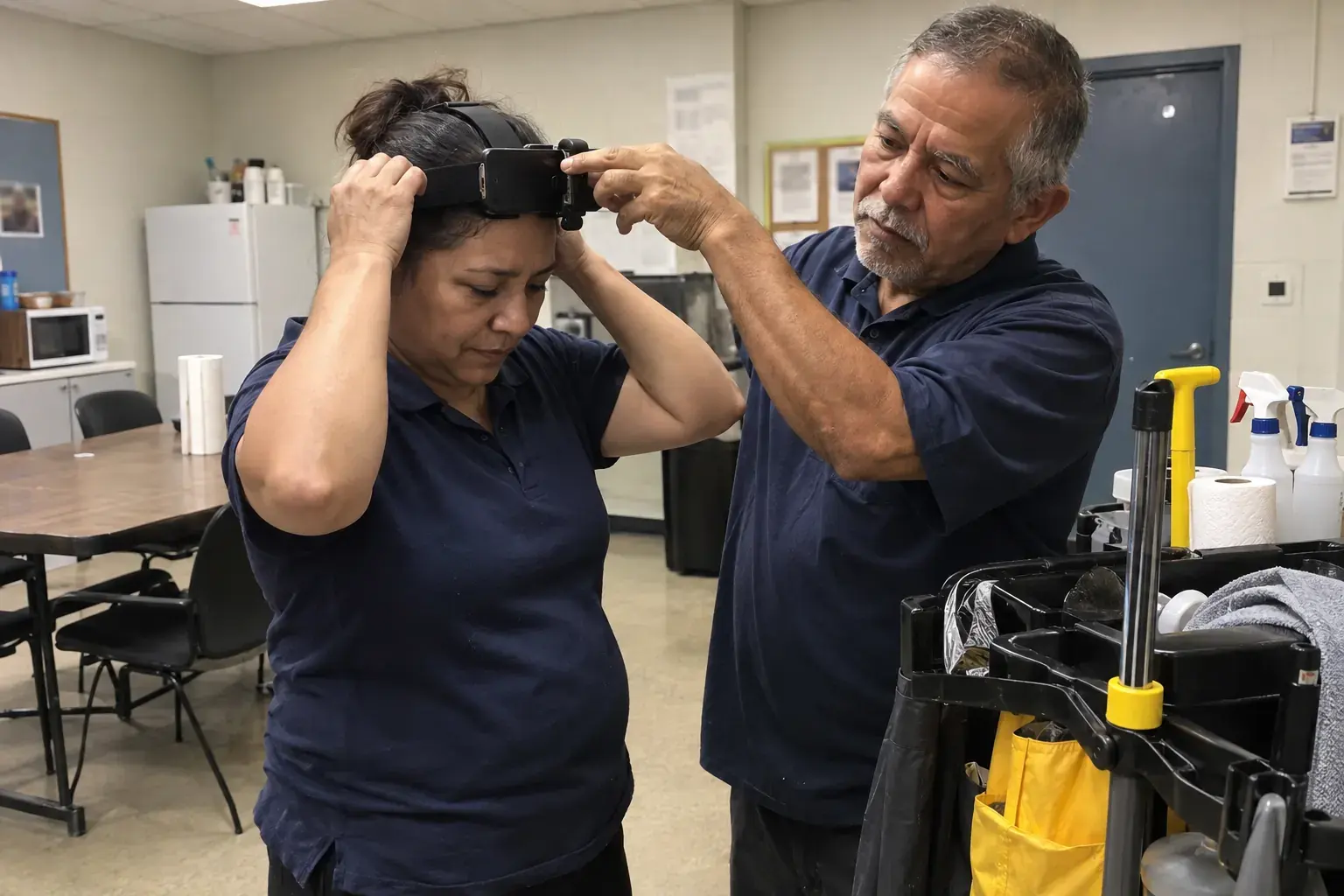
You wear your phone on a headband, at your forehead, pointed down at your hands. It films what you see while you wipe a sink or pull a trash liner.
AI and robot teams use video like this to learn how a person moves through a task. Where do the hands go first? How hard do you press on a stuck spot? That is the part of cleaning a robot can't figure out alone.
Why companies want it
There is a lot of text and photos online. There is very little video of real hands doing real work. A 2025 Apple research paper called EgoDex said it plainly: there is no internet-sized collection of this kind of data.
Robot makers are filling that gap with human video. Figure, a robot company, says its newest robot brain learned from over 1,000 hours of human motion data. Figure also pays people through an app to film their own tasks. These are examples of the field. We don't say who uses our video.
What it means for you today
Today it means paid work on a shift you were already doing. You get $10 to $15 for each accepted hour. The exact rate is confirmed in writing after your first accepted hour.
It does not mean a robot is coming to your building next month. The robots you might see at work today scrub open floors. Wiping a toilet base or a break room table is still your job, and the next articles show why.
Why we tell you straight
Some cleaners will ask if they are training their own replacement. That is a fair question, and a vague answer would be worse than none. So we wrote this section with real numbers and links you can check.
We came out of building services ourselves. We would want to know what our video was for, so we are telling you.
You know this work better than any robot team does. Your video is paid at $10 to $15 per accepted hour, and it shows you up close how robots learn cleaning.
What other owners ask
Is the video used to build robots that clean?
It helps AI and robot teams learn how cleaning is done. Some of that work is for robots. We don't name who uses it, and we can't tell you what each team builds.
Am I training my own replacement?
Robots are still years away from doing most of a cleaner's shift. The article on how far away robots are gives our best read and the research behind it. We won't promise a date either way.
Can I say no?
Yes. Only people who agreed to be recorded during their job should be in a recording. Talk with your employer if you don't want to wear the camera.
Where to read more
- EgoDex: Learning Dexterous Manipulation from Large-Scale Egocentric Video (arXiv, 2025)
- Figure: Introducing Helix 02 (January 2026)
- Figure: Index app page
These are public examples from other companies. They are not Colby partners or customers.