
Most commercial cleaning operators can price a building in their heads before they reach the parking lot. The bidding tool is not there to do the math. It is there to close the distance between knowing the number and putting it in front of the prospect. This guide names the credible bidding and proposal tools and sorts them by how they work, with a marker for where a custom quoting build pays off instead.
The bidding tools, by how they work
Every tool below turns a walkthrough into a priced proposal. They differ in where they put the work: some are calculators you feed at the office, some run on a phone at the site, some care most about the finished document. Match the approach to where your bid time actually leaks. This page sits under the janitorial software category guide, which covers the rest of the market. If you just want a number to anchor a bid, the free janitorial quote calculator prices a building from its size, your pay, and your margin in about a minute.
CleanGuru (the CleanBid engine) is the most recognized name here, with hundreds of thousands of proposals run through it. You enter room measurements and fixture counts, and it applies production rates to estimate cleaning times and generate a branded proposal. CleanlyRun walks you through a similar build in a fixed set of steps. Both are strongest when your pricing maps cleanly to square footage and standard production rates.
Route BID captures areas, measurements, floor types, fixtures, and photos from a phone during the walkthrough, then prices the job and sends a same-day proposal with e-signature. The pitch is speed: the prospect can have a number before the rep leaves the lot. Good fit when most of your bid time is lost to the drive back and the re-keying that follows.
Clean Proposals and Method Clean Biz lean toward the document: branded, presentable proposals with the pricing math handled underneath. Janitorial Manager includes a bidding module inside a broader operations suite, so estimators bid consistently against one set of loaded settings. These suit teams whose problem is less the number and more the inconsistent paperwork around it.
Newer tools like QuotePro layer pricing suggestions on top of the estimate. The logic still lives inside the vendor's model, so it works well when your jobs look like the average job the tool was tuned for, and less well when your margins come from how you specifically price a route or a difficult account.
When an off-the-shelf bid tool is the right call
For a lot of cleaning companies, a bidding app is all the software the sales side needs. If your pricing follows standard production rates and the main thing slowing you down is the re-keying after the walkthrough, a tool like CleanGuru or Route BID solves that directly and stays solved for years. Buying one is the correct move, and you should not over-build past it. See how a custom build compares to CleanGuru and Route BID, or the two tools head to head. A guided step-by-step builder like CleanlyRun has its own comparison page as well, and so does the starter toolkit JaniBid.
These tools are also fair to evaluate on their own terms. They are mature, with enormous volumes of priced work behind them, and the proposals they produce look clean. The question is not whether they are good. It is whether the way you win and keep accounts fits inside the model they expect you to use.
Where custom quoting fits instead
An off-the-shelf bid calculator prices the way the vendor decided cleaning companies should price. That holds until your margin comes from something the tool does not model: a route density only you understand, a labor-burden rule specific to your union or market, an add-on structure you negotiated, or a pipeline the quote needs to land in automatically.
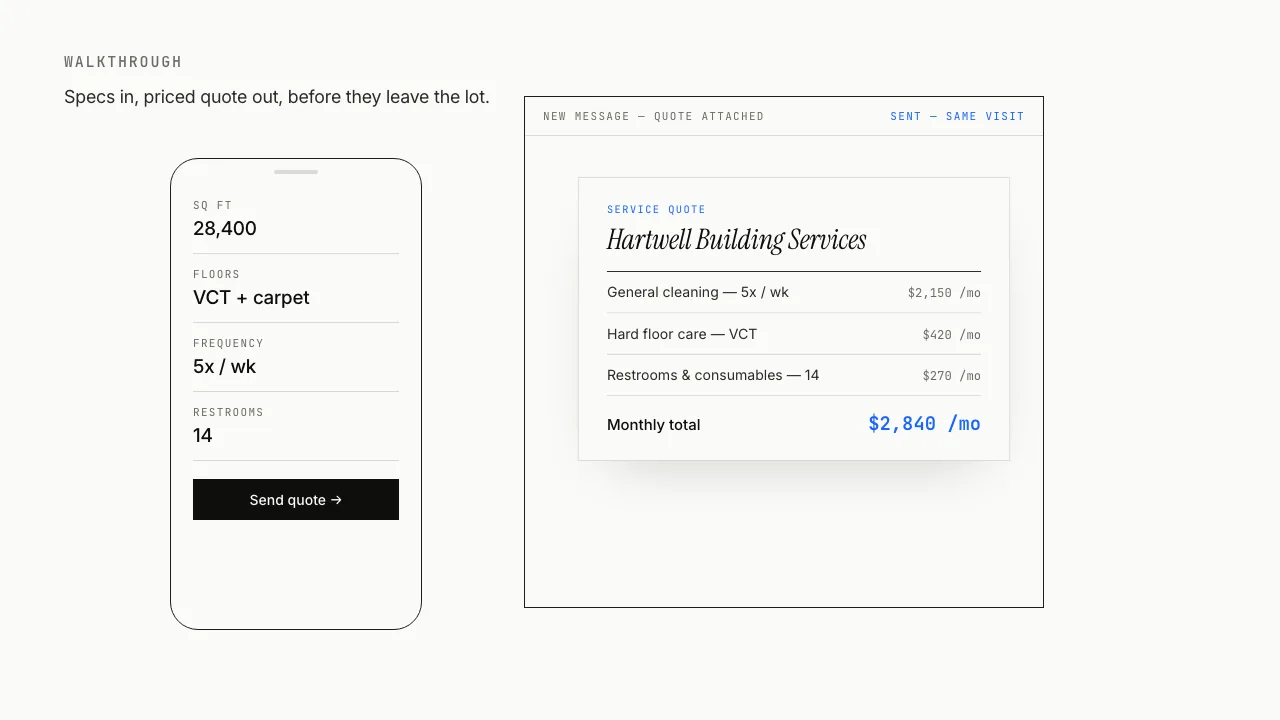
When we built a custom quoting flow for one janitorial operator, the rep entered the walkthrough on the phone inside the building. The system applied that company's own pricing logic, and the formatted quote went out before the rep left the lot. Standard jobs skipped the approval queue. The owner stopped reviewing individual bids and started owning the pricing model instead. You can see the full version on the instant quoting use case, what the build itself involves on the custom quoting AI page, and how custom compares to packaged products on the BrightGo and OrangeQC pages.
Service type, square footage, frequencies, fixture counts, and add-ons captured on the phone inside the building. Your pricing logic applied, a clean quote formatted and addressed to that prospect, sent before the rep leaves the lot.
Labor rates, margin targets, and production assumptions live in one model you control. Update them once and every future quote inherits the change, so pricing stops depending on the one manager who knows the spreadsheet.
The quote lands in the systems you already run, so a sent proposal becomes a tracked opportunity instead of an attachment in someone's outbox.
How to choose
Start with where the bid actually slows down. If the time leaks on the drive back and the re-entry, an on-site mobile tool fixes that. Estimators who price the same building different ways every time need a workloading calculator with loaded settings for consistency. And when the proposal document itself is the weak link, a proposal-first tool earns its keep.
The signal for a custom build is different. It shows up when the pricing logic that wins your accounts will not fit inside any product's template, or when the quote has to flow into a pipeline the bid tool does not touch. Colby starts with a three-week discovery that maps how a bid moves through your company, then delivers a readout: a prioritized menu of builds you choose from. You own what we build, and we host and maintain it. The fastest way to see where you stand is to start a quote or score your operation.
Common questions
How long should a commercial cleaning bid take to turn around?
The walkthrough itself runs under an hour, but most operators take days to get a number in front of the prospect because the bid is re-keyed from paper into a spreadsheet, then waits on an owner approval and formatting. Bidding software collapses that to same-day, and a custom build can send the proposal before the rep leaves the lot.
What is the best janitorial bidding software?
It depends on how your pricing works. Workloading calculators like CleanGuru and CleanlyRun fit when your bids map to standard production rates. Route BID captures the walkthrough on a phone for a same-day proposal. A custom build fits when your margin comes from pricing logic a shared calculator does not carry.
Do I need bidding software or a custom quoting build?
An off-the-shelf bidding app is the right buy when your pricing follows standard rates and the main delay is re-keying after the walkthrough. A custom build earns its place when your pricing is the edge that wins accounts, or when the quote needs to land in a sales pipeline the bid tool does not reach.
Can a quoting tool use my own production rates and labor burden?
Off-the-shelf calculators apply the vendor's workloading model, which you can tune within limits. A custom quoting build runs on your own production rates, labor burden, and margin targets, so a quote reflects how you actually price rather than a model every cleaner shares.
How does a Colby quoting build work?
The rep enters the walkthrough on a phone inside the building. Your own pricing logic prices it, and a formatted proposal goes out addressed to that prospect. It starts with a three-week discovery that maps how a bid moves through your company, then a readout of build options you choose from.
More software guides
Tell us what you are evaluating. We will reply within one business day and walk you through what the custom path would look like for your operation, including whether a discovery is worth it before you commit to a platform.
Reply within 1 business day · NDA-friendly · No build prices before discovery